
After a European Championship held in front of sparse attendances due to COVID restrictions in 2021, and a World Cup 18 months later held in tandem with the hanging of Christmas decorations, the football calendar is finally back in sync as UEFA’s showpiece event descends on Germany over the next month.
The nation staged a memorable World Cup 18 years ago, and with glittering stadia, an exceptional transport network and a long-established genuine football culture to call upon, it should prove to be a very popular host.
The home team will hope for a similar renaissance to the one they enjoyed in 2006, when they came into the tournament with more questions than answers but inspired a country with an array of dazzling performances as they swept to the semi-finals. They haven’t been in the last eight of a major competition since Euro 2016, so that is the bare minimum that Julian Nagelsmann must achieve.
Holders Italy won’t be among the favourites to retain the trophy but will be out to prove a point after missing the last two World Cups. After a lean decade, Spain’s Nations League triumph a year ago has revived hopes that they could be there or thereabouts, while Portugal have a group of outstanding players, many of whom are in their peak footballing years.
Having come within a penalty shootout of winning back-to-back World Cups, France go into Euro 2024 as favourites, but that was also the case three years ago when they exited in the last 16. England are also shooting for the stars, having had to settle for silver at Euro 2020 but able to call upon several key players who are in the form of their life.
Belgium are out for redemption after their group stage exit at Qatar 2022, while Netherlands will hope to build upon their quarter-final appearance at that tournament and Croatia may be targeting a first European semi-final. Elsewhere, the likes of Hungary, Austria and perhaps even Scotland may emerge as surprise teams to go far.
Ukraine’s players will be striving to do their best for their people back home amid the ongoing war, while another ex-Soviet nation in Georgia are out to spring a shock or two on their first-ever major tournament appearance.
With a small pool of likely contenders (but no clear favourite), a handful of nations who may fancy their chances of going deep into the tournament, and a few outsiders eyeing an upset for the ages, Euro 2024 promises to be enthralling. The last edition three years ago started slowly but caught fire towards the end of the group stage and threw up thrills aplenty.
Let’s analyse the 24 competing teams in further detail and assess their chances in Germany over the coming month.
GROUP A

GERMANY
Similar to when they hosted the World Cup in 2006, Germany go into this summer’s Euros with a reputation to restore after several drab tournaments. For so long a beacon of consistency on the big stage, Die Nationalmannschaft are overdue even a quarter-final appearance, so anything less would be a calamity, especially on home soil.
After a miserable 2023 which saw Hansi Flick given the chop, Julian Nagelsmann has instigated some improvement, with wins over France and Netherlands in March offering hope that a corner may have been turned just in time for opening night against Scotland on Friday.
In another parallel to 18 years ago, Germany are seeing some truly gifted youngsters starting to come of age. Florian Wirtz was immense in Bayer Leverkusen’s historic Bundesliga triumph, whle Jamal Musiala on the right flank is a joy to watch. Kai Havertz takes up the false 9 role off the back of an impressive finish to the season with Arsenal, while the experienced Ilkay Gundogan is a master of his craft. Expect the Germans to retain possession expertly and press relentlessly.
I’ve been left with egg on my face with my predictions for the three-time European champions in the last two World Cups, but surely this group of players on home soil goes deep into the tournament? I’d be surprised if they don’t get to the semis at least, although they might fall narrowly short of adding a fourth continental crown.
Probable XI: Neuer – Kimmich, Rudiger, Tah, Mittelstadt – Andrich, Kroos – Musiala, Gundogan, Wirtz – Havertz
Euros history: Joint-record winners with three titles (1972, 1980, 1996), Germany have also been losing finalists on three other occasions (1976, 1992, 2008).
Verdict: Germany to breeze through until the quarter-finals and then beat Spain and Portugal, but come up short at the final hurdle.
HUNGARY
Hungary are appearing at their third consecutive European finals, having given a good account of themselves on their previous two appearances. They topped a group featuring eventual winners Portugal in 2016 and were unfortunate to come bottom of a foursome with the Portuguese, France and Germany three years ago.
They’ve taken some big scalps since then, too, including a 4-0 away drubbing of England in the UEFA Nations League and a win over the hosts of this tournament. They were unbeaten in qualifying, too, and have an affable yet shrewd tactician in Marco Rossi at the helm, with the Italian having also led them to Euro 2020.
Liverpool playmaker Dominik Szoboszlai is the undoubted star of the team, and he’ll be out to prove a point after missing the previous Euros through injury. Hungary tend to use their wing-backs very effectively, with Loic Nego and Milos Kerkez given licence to bomb forward at will. In midfield, Adam Nagy is the beating heart of the team, keeping things ticking over between the thirds.
With a much kinder group draw this time than at Euro 2020, the Magyars should have enough to progress to the knockout stage, and a quarter-final isn’t out of the question, but a difficult tie in the last 16 awaits. Anything beyond that would be an excellent showing.
Probable XI: Dibusz – Lang, Orban, A Szalai – Nego, A Nagy, Schafer, Kerkez – Sallai, Szoboszlai – Varga
Euros history: Twice semi-finalists, but that was back in 1964 and 1972. Reached the second round in 2016 and were unlucky to fall at the group stage three years ago.
Verdict: Second in the group before shipping a dignified defeat to Croatia in the round of 16.
SCOTLAND
Normally cutting it fine when it comes to qualification for major tournaments, Scotland breezed through a tricky group this time around to reach Euro 2024 in style, but now comes the hard part – kicking the habit of a lifetime.
They’ve never made it out of the group stage at either a World Cup or European Championship, and that is the monkey that Steve Clarke’s side are trying to get off their backs. Had this tournament been held a year ago, the Scots would 100% have fancied themselves to break through the glass ceiling, but results have taken a turn for the worse in the meantime, including a 4-0 thrashing by Netherlands in March.
Although Scotland have two prolific midfielders in John McGinn and Scott McTominay, and one of the world’s best left-backs in Andy Robertson, the lack of a true top-quality centre-forward could prove their undoing. Che Adams and Lawrence Shankland bring their own attributes to the table, and combined they’d make for an outstanding number 9, but both also has a crucial shortcoming. Clarke’s options are also hindered by the absence of Lyndon Dykes through injury.
The Tartan Army will play a blinder in the support stakes, but whether the team can rediscover the form which saw them beat Spain and secure a dramatic late win in Norway is the burning question. Will the weight of history burden them once again this summer?
Probable XI: Gunn – Ralston, Porteous, Hendry, Tierney, Robertson – McTominay, McGregor – McGinn, Christie – Adams
Euros history: Qualified for three previous editions (1992, 1996, 2020), exiting at the group stage each time.
Verdict: The classic hard luck tale of being one of the two third-place group finishers not to go any further.
SWITZERLAND
Switzerland are usually steady operators at major tournaments and were a penalty shootout away from being semi-finalists at Euro 2020, but they’ve yet to recover from the debacle of losing 6-1 to Portugal at the 2022 World Cup.
They came through qualification for this year’s finals but made heavy weather of a group they’d have expected to stroll through, making an unhappy habit of dropping points late in matches. It’s led to the previously deified coach Murat Yakin becoming a lightning rod for criticism back home, and it’ll take more than an affable personality for him to recover the support of the Swiss public.
The 49-year-old has tried a variety of formations to get a tune out of his squad, but none has been an unqualified success. The play will invariably go through inspirational captain Granit Xhaka, who’s been excellent for Bayer Leverkusen, and they have a solid centre-back partnership in Manuel Akanji and Nico Elvedi. Similar to Scotland, though, none of their forwards are truly convincing. Zeki Amdouni hasn’t pulled up any trees at Burnley, while Breel Embolo is gifted but alarmingly injury-prone.
A repeat of their quarter-final showing from three years ago looks most unlikely, and even getting out of the group could be a tall order for a team who’ve yet to get over their bruising exit from the World Cup 18 months ago.
Probable XI: Sommer – Widmer, Akanji, Elvedi, Rodriguez – Freuler, Zakaria, Xhaka – Vargas, Embolo, Okafor
Euros history: Their quarter-final placing three years ago was their best performance in the Euros. Qualified for six of the last eight editions including 2024.
Verdict: A first group exit at a major tournament since the 2010 World Cup.
GROUP B

ALBANIA
Reaching a second European Championship out of three is a tremendous achievement for a nation of Albania’s size, and they didn’t sneak in the back door either, having topped what was admittedly a weak qualification group.
Unfortunately for them, they’ve landed three behemoths in their group, although they could view that as a positive in that expectations at home and abroad will be minimal – even getting a point would constitute an honourable showing. Their coaching ticket poses a couple of names who are well known to football followers in the UK and Ireland – they are led by ex-Arsenal defender Sylvinho, with Pablo Zabaleta as his assistant.
The players don’t quite have as ubiquitous a profile, although several have experience at big clubs in Europe. Centre-back Berat Djimsiti was in Atalanta’s victorious Europa League side, while striker Armando Broja can count Chelsea on his CV. Midfielder Kristjan Asllani plays with Inter Milan and right-back Elseid Hysaj had a good few years at Napoli. One less familiar name worth looking out for is Ernest Muci, who’ll be pushing for a start in attack.
Albania will go to the Euros without any fear, and with plenty of know-how at a high level of club football, but their group stage draw has been nastier than Dolores Umbridge in the fifth Harry Potter book. They’ll eye a scalp and might take one memorable result, but shouldn’t expect too much beyond that.
Probable XI: Berisha – Hysaj, Ismajli, Djimsiti, Mitaj – Asllani, Ramadani – Asani, Bajrami, Seferi – Broja
Euros history: Their one previous appearance was in 2016, when they were one of the two third-placed sides to exit at the group stage, but they went home with credibility gained.
Verdict: Finishing ahead of even one of Spain, Italy and Croatia looks to be beyond this Albania side, but they’ll seek to thrive on the element of surprise.
CROATIA
Considering how excellent they’ve been at a few World Cups over the years, it seems an anomaly that Croatia have never won a knockout match at the European Championship since their debut appearance in 1996.
Since their bronze medal showing in Qatar 18 months ago, they’ve come agonisingly close to winning their first silverware, only to be denied by Spain on penalties in the UEFA Nations League final last year. Those are remarkable feats for a country of just four million people and a team who always seem to win the hearts of neutral football fans.
Croatia boast an imperious midfield featuring the experienced Marcelo Brozovic and Mateo Kovacic and, of course, the grand old master Luka Modric, still pulling the strings at 38. The defence is marshalled by Manchester City’s Josko Gvardiol, while goalkeeper Dominik Livakovic excels in penalty shootouts, the means by which Zlatko Dalic’s team have won four matches across the last two World Cups.
Despite facing teams who’ve won three of the last four European Championships, the Croatians will fancy their chances of getting through and – guess what – might even win a knockout match this time. What we know for sure is they won’t bow submissively to any team on the continent.
Probable XI: Livakovic – Juranovic, Sutalo, Gvardiol, Sosa – Brozovic, Modric, Kovacic – Kramaric, Budimir, Ivanusec
Euros history: This is their seventh appearance out of the last eight, and their sixth in a row. Quarter-finals showings in 1996 and 2008 have been their best so far.
Verdict: Croatia to finish second in the group and progress to the quarter-finals, where England avenge their 2018 World Cup semi-final defeat.
ITALY
Surprise winners of Euro 2020, Italy have leaned heavily upon UEFA’s flagship tournament for reasons to cheer in recent years, having sensationally missed out on the last two World Cups either side of that Wembley triumph over England.
The Azzurri looked like anything but potential back-to-back champions in qualifying, losing twice to Gareth Southgate’s team and somehow avoiding the concession of what looked a certain penalty in their draw against Ukraine in their final qualifier, when defeat would’ve consigned them to the play-off route which did for their World Cup aspirations for 2018 and 2022. The holders’ cause wasn’t helped by the abrupt departure of Roberto Mancini for Saudi Arabia, either, but they could hardly have hired a better replacement in Luciano Spalletti, the man who led Napoli to their runaway Serie A triumph last year.
Defensively they don’t look as secure as three years ago, with the powerhouse duo of Giorgio Chiellini and Leonardo Bonucci now both retired and Francesco Acerbi a huge loss through injury, although they have an excellent central midfield in the composed Jorginho and the livewire Nicolo Barella. Up front, the naturalised Mateo Regeui will lead the line, with Federico Chiesa also a danger man – if he can stay fit.
Most of Italy’s tournament triumphs stem from adversity and upsetting the odds, but it’d be a big surprise if this current crop were to successfully defend their title. The last two defending champions have both exited in the round of 16, a sequence which could be extended at Euro 2024.
Probable XI: Donnarumma – Di Lorenzo, Mancini, Bastoni – Cambiaso, Barella, Jorginho, Dimarco – Pellegrini, Chiesa – Retegui
Euros history: Euro 2020 was their second triumph in the competition, having also won in 1968. Only qualified three times prior to 1996 but have been ever-presents since then, losing the final in 2000 and 2012.
Verdict: Italy will do enough to get out of the group, something they didn’t manage as defending champions at the 2010 World Cup, but may be bested by Portugal in the round of 16.
SPAIN
Aside from a semi-final appearance at Euro 2020, Spain have reverted to being big-name flops at major tournaments over the past decade, following on from their all-conquering peak of 2008-2012. However, winning the UEFA Nations League 12 months ago has at least helped to shed the weight of history which has crippled them in recent years.
La Roja have a love-hate relationship with penalty shootouts. They won one against Switzerland at the last Euros and defeated Croatia by that method in the Nations League final, but have seen their last three major tournaments ended by spot kicks (Russia 2018, Italy 2021, Morocco 2022). At least they go to Germany in strong fettle, overcoming defeat to Scotland early in the qualifiers to sail smoothly into the finals under Luis de la Fuente.
Although the cast of characters has changed entirely from the 2008-2012 heyday, many of the traits of that legendary team are evident in this Spain side. Possession is king, although that can sometimes be to the detriment of a cutting edge. It’s up to the front three of the enigmatic Alvaro Morata, cultured Dani Olmo and teenage star Lamine Yamal to provide that. Rodri patrols the midfield, with the stardust provided by Pedri, if the Barcelona gem isn’t held back by persistent injury problems.
If the Spaniards can come through the group stage in a favourable position, the knockout rounds might then open up for them. They’ll want to reach at least a quarter-final to show that they can get back to being a genuine force in European football.
Probable XI: Simon – Carvajal, Le Normand, Laporte, Grimaldo – Merino, Rodri, Pedri – Yamal, Morata, Olmo
Euros history: Tied with Germany for the most wins (three in 1964, 2008 and 2012). Also reached the final in 1984 and the semis three years ago.
Verdict: Spain are good enough to win the group, which’d bring with it a favourable round of 16 tie. I don’t see them going any further than the last eight, though.
GROUP C

DENMARK
The neutrals’ favourites at Euro 2020 have redemption on their minds this summer after a disastrous World Cup in Qatar when they failed to progress from a group which should’ve been negotiable. That setback has led to Danish supporters revising their expectations for this year’s trip to Germany.
Kasper Hjulmand’s side appeared to have a hangover from their 2022 disappointment in the qualifiers for this tournament, throwing away a 2-0 lead to suffer a shock defeat to Kazakhstan and also being beaten by an average Northern Ireland team. Such results don’t offer much hope that they can suddenly flick a switch and land a killer blow on Europe’s leading lights, like they did when beating France in the UEFA Nations League two years ago.
However, Denmark boast a tactical flexibility which sees their line-up frequently adapted to best suit the individual challenge that awaits them. Christian Eriksen may have had a below-par season with Manchester United, but he remains the creative hub of his national team. If he and his teammates can supply quality service to Rasmus Hojlund, they stand a chance of winning any game. Much could also depend on wing-back duo Joakim Maehle and Victor Kristiansen, with the former having starred as one of the best players at Euro 2020.
Nobody is expecting a repeat of their heroic run to the semi-finals three years ago, but another group stage exit like in Qatar is unacceptable. Getting to the last 16 is the minimum requirement; going any further would represent a successful showing.
Probable XI: Schmeichel – Andersen, Kjaer, Christensen – Maehle, Hojbjerg, Jensen, Kristiansen – Eriksen – Dolberg, Hojlund
Euros history: Shock winners in 1992 after they were a late replacement for war-torn Yugoslavia, they’ve fallen at the semi-finals three times, an impressive return for a nation of their size.
Verdict: Denmark have sufficient quality to make it out of their group, but probably not enough to progress beyond a likely meeting against Belgium in the round of 16.
ENGLAND
Long gone are the days that reaching the semi-finals at the 2018 World Cup was greeted with euphoria in England. That was Gareth Southgate’s first major tournament in charge of the Three Lions; going into his fourth this summer, the remit is simple – bring the trophy home.
It felt as if they may have missed their big chance when surrendering a lead in the Euro 2020 final to lose on penalties, but few nations in world football can boast a crop of players as talented as this current English squad. They have previously been weighed down by the notorious ‘Golden Generation’ tag , most notably under Sven-Goran Eriksson in the mid-2000s, but Southgate’s side appear much more harmonious than the team of Beckham, Owen, Lampard, Rooney et al.
From midfield onwards, the England team is stacked with world-class quality. Harry Kane has been as prolific as ever despite Bayern Munich’s troubled season. Jude Bellingham is a genuine Ballon D’Or contender. Phil Foden has been in the form of his life, while Bukayo Saka and Declan Rice both excelled in Arsenal’s Premier League title challenge. Breakthrough starlet Kobbie Mainoo could even be pushing for a start. However, it’s the defence and goalkeeper which may prove the team’s undoing once they get to the business end of the tournament, especially with injuries plaguing the backline.
The goal is to win it, but as the Three Lions know all too well, there’s a very fine line between being in contention to lift the trophy and actually doing so. Despite some worrying results in 2024 so far, the path to the semi-finals seems very manageable, but they could find France too tough a nut to crack. Once again, they’ll go close but fall short of the winners’ podium.
Probable XI: Pickford – Walker, Stones, Guehi, Shaw – Alexander-Arnold, Rice – Saka, Bellingham, Foden – Kane
Euros history: Regular qualifiers but didn’t reach the final until Euro 2020. Semi-finalists on two other occasions (1968 and 1996).
Verdict: Similar to the last World Cup, they’ll breeze through to the quarter-finals before meeting their first serious test. England should be in the final four, but that may be where the story ends. Again.
SERBIA
Although Serbia have reached four of the last five World Cups (counting 2006 when they participated as Serbia & Montenegro), this is their first European Championship in their current guise, with the nation last represented on the continental stage as Yugoslavia 24 years ago.
Having gone to Qatar 2022 with high hopes before crashing out at the group stage, confidence has yet to be restored, with the qualification campaign for Germany throwing up more questions than answers about Dragan Stojkovic’s side. The only team of any tournament-level quality that they faced (Hungary) beat them twice, while a Russia outfit starved of competitive football since the start of the war on Ukraine two years ago thrashed them 4-0 in March. That doesn’t augur well for Serbian hopes at the finals, with supporters desperately left praying that things just might turn out alright on the night this summer.
Debate rages back home as to whether they should start with two or three central defenders, with that dilemma likely to be determined by player availability and the nature of the opposition for each game. Their main sliver of hope is the riches they have in attack, with the prolific Aleksandar Mitrovic leading the line, the classy Dusan Tadic playing in behind him, and Juventus centre-forward Dusan Vlahovic a potentially game-changing substitute if needed. The front men will be heavily relied upon to produce moments of magic which might just help Serbia through.
If they’re blunt in attack, it’s difficult to see how a team with defensive issues will be able to cope with some of the forwards they’ll be facing in Group C. The likes of Kane, Hojlund and Sesko could have a field day against a far from awe-inspiring Serbian defence.
Probable XI: V Milinkovic-Savic – Milenkovic, Veljkovic, Pavlovic – Zivkovic, Gudelj, Lukic, Kostic – S Milinkovic-Savic, Tadic – A Mitrovic
Euros history: This is their first time qualifying as Serbia. The former Yugoslavia lost two of the first three finals of this competition in the 1960s, and were semi-finalists when they hosted in 1976.
Verdict: England and Denmark could punish them heavily if they’re in the mood, while Slovenia might also fancy their chances of beating their Balkan rivals. It could be a short and miserable stay in Germany for Stankovic and co.
SLOVENIA
Slovenia are back at the European Championship for the first time since 2000, having been to two World Cups since then, with the most recent being South Africa 2010 when they almost eliminated England in the group stage.
They famously drew 3-3 against Yugoslavia in their tournament opener 24 years ago, having led 3-0 at one point, and will be out to get one over on their fellow Balkan outfit this summer. They’ll also have another crack at the Three Lions after their World Cup elimination in 2010, although that was a far less cohesive English side than Gareth Southgate’s current crop. They’ll hope to emulate neighbours Croatia by belying their comparatively meagre population to compete with aplomb on the big stage.
In another link to their last World Cup appearance 14 years ago, Slovenia are led by Matjaz Kek, who was also the coach at that tournament in South Africa. He can call upon elite operators at both ends of the pitch – Jan Oblak in goal and Benjamin Sesko up top. The Slovenians could be a threat at set pieces, with each of their forwards well over 6 feet tall, and they pose a threat from out wide with Jan Mlakar on the left. The chink in their armour could be the apparent lack of a plan B if the livewire Adam Cerin is kept quiet in the middle of the park – almost all of their attacks flow through him to some degree.
Many might consider Slovenia to be the outsiders in this group but theirs is a talented line-up which also functions well as a unit. They’re good enough to beat Serbia, which’d likely see them edge into the knockout rounds. That would duly be seen as mission accomplished.
Probable XI: Oblak – Karnicnik, Blazic, Bijol, Janza – Stojanovic, Cerin, Elsnik, Mlakar – Sesko, Sporar
Euros history: Their only other appearance was in 2000, when they drew twice as rank outsiders but didn’t manage to get out of their group.
Verdict: Slovenia to make it out of the group stage before respectably bowing out to Germany in the round of 16.
GROUP D
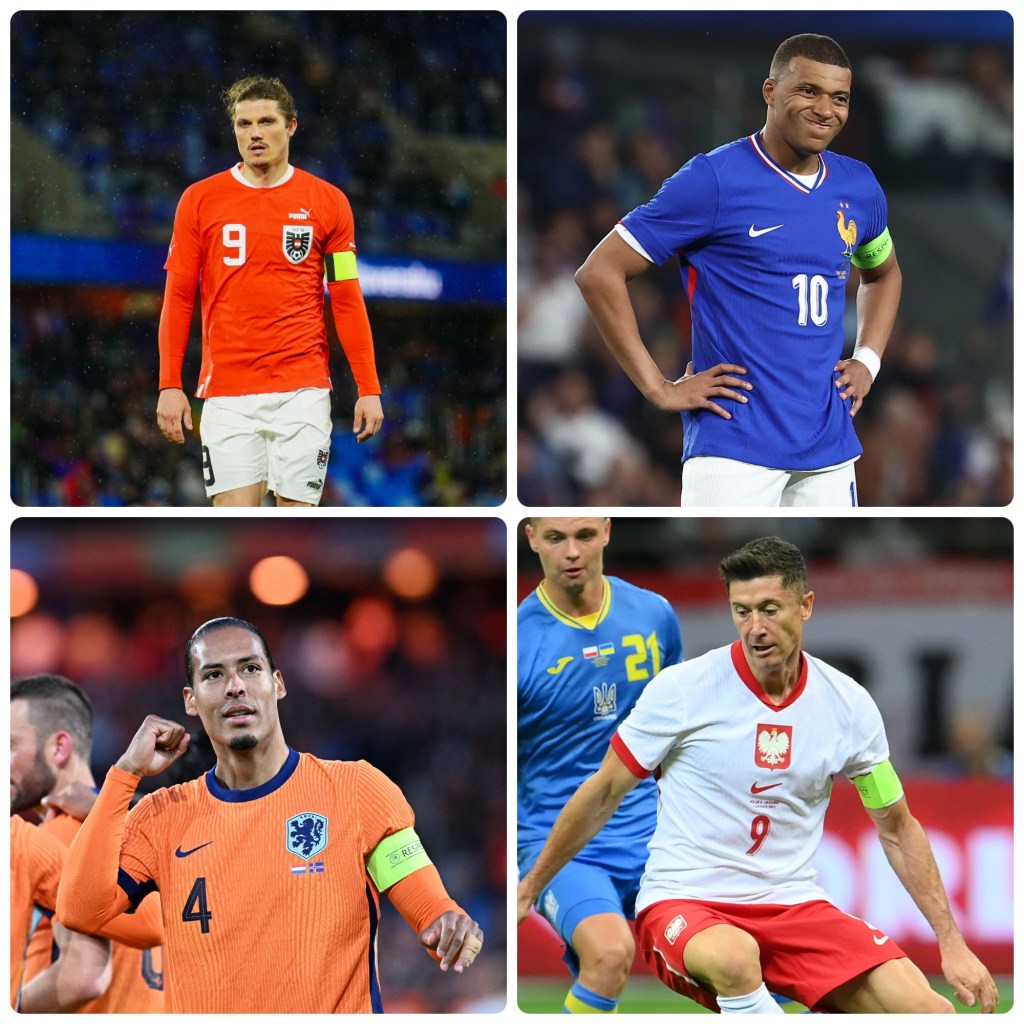
AUSTRIA
Austria were in the doldrums when Ralf Rangnick took charge two years ago, but the ex-Manchester United boss has instigated a significant turnaround in the central European side, who qualified convincingly for their third successive continental finals and their fourth out of the last five since their debut as co-hosts in 2008.
Austrian fans won’t make the same mistake as eight years ago, when the comprehensive manner of their qualification saw them arrive in France as potential dark horses for the trophy but leave with their noses bloodied by meekly finishing bottom of their group. Expectations are being kept in check this time, even with the vast improvement they’ve shown in the past 24 months – a big part of that may also be the absence of key duo David Alaba and Sasa Kalajdzic through serious injuries.
Rangnick still has some quality players to call upon, though, most notably the midfield duo of Marcel Sabitzer and Konrad Laimer. In general, the team is more than the sum of its parts, with the coach’s imprint of a high-pressing game evident within minutes of watching them in action. It’s the 65-year-old who’s held up as the man from whom Jurgen Klopp, Thomas Tuchel and Julian Nagelsmann each derived the ‘gegenpressing’ template and tweaked it to make it their own.
A repeat of their showing from three years ago, when they got out of the group and took eventual champions Italy to extra time in the round of 16, would be considered a decent return, especially in a group containing two of the eight World Cup quarter-finalists from Qatar 2022.
Probable XI: Lindner – Posch, Lienhart, Wober, Mwene – Seiwald, Grillitsch – Laimer, Baumgartner, Sabitzer – Gregoritsch
Euros history: Group stage fallers in 2008 and 2016, they made it to the last 16 at Euro 2020.
Verdict: Third in the group and advancing to the last 16, where England should get the better of them.
FRANCE
Their shock round of 16 exit at Euro 2020 has proven to be an aberration, with France reaching the final of three of their last four major tournaments. The 2018 World Cup winners came within a penalty shootout of defending their title in Qatar 18 months ago and, with an abundace of world-class quality to call upon, go to Germany as favourites for a third European triumph, despite a disappointing draw to Canada in a recent friendly.
Similar to Gareth Southgate with England, Didier Deschamps still faces criticism back home for his perceived negative tactics, when in fact his pragmatism and ability to blend a gifted group of players into an effective, high-performing unit has made Les Bleus a genuine force over the past decade. Perhaps it’s not until his reign ends and the French fall back into the pack that the ex-Monaco coach will be viewed through a more glowing prism by his country’s populace.
France have top-class operators in every line of the pitch, from Mike Maignan in goal to Dayot Upamecano at centre-back, the indefatigable Aurelien Tchouameni in midfield, the evergreen Antoine Griezmann and a frightening front three of Ousmane Dembele, Olivier Giroud and Kylian Mbappe. It speaks volumes for the quality at Deschamps’ disposal that the likes of William Saliba, Benjamin Pavard, Eduardo Camavinga, Kingsley Coman and Randal Kolo Muani seem more unlikely than likely to start at Euro 2024, at least initially.
The French blew it at the last two European Championships, somehow failing to beat a pragmatic Portugal on home soil in the final eight years ago and exiting on penalties to Switzerland in a madcap round-of-16 tie at Euro 2020. I tipped them to win the tournament on both occasions, but unperturbed by those results, I’m backing them again this summer. They have the best squad and, in all probability, the best team in Europe right now.
Probable XI: Maignan – Clauss, Konate, Upamecano, T Hernandez – Tchouameni, Rabiot, Griezmann – Dembele, Giroud, Mbappe
Euros history: Winners in 1984 and 2000, they finished as runners-up in 2016 and have lost twice in the semi-finals.
Verdict: Les Bleus will atone for losing major finals in 2016 and 2022, with Deschamps’ legacy secured once and for all by becoming the first man to win both the Euros and the World Cup as both a player and a coach.
NETHERLANDS
Ronald Koeman is back to finish what he started. Having led Netherlands to Euro 2020, only to quit on the eve of the tournament to take the Barcelona job, Martin O’Neill’s adversary has guided his nation to the European Championship once more. With the recent vacancy at Camp Nou now filled by Hansi Flick, the 61-year-old won’t be defecting from the national team this summer.
His second spell in charge of the Oranje began inauspiciously with a 4-0 hammering by France, but the curve has travelled steadily upwards since then, and a draw with Les Bleus in the reverse fixture last autumn suggested that the 1988 winners can mix it with the continent’s best. A pair of convincing 4-0 wins in pre-tournament friendlies have also injected fresh confidence.
It’s not the most star-studded Dutch team of all time but they can call upon a generational centre-back in Virgil van Dijk, an outstanding wing-back in Denzel Dumfries and a potentially explosive forward in Memphis Depay, if he’s in the mood. However, they lack a top-level number 9 in the mould of Ruud van Nistelrooy and a playmaker of Wesley Sneijder’s genius, and none of their goalkeeping options seems truly convincing. They’ve also been struck by injuries to Frenkie de Jong and Teun Koopmeiners in recent days, depriving them of two of their most creative midfielders.
Netherlands will show enough to get out of the group but, similar to when Czech Republic knocked them out of Euro 2020, I can see them being the victims of a surprise elimination in the round of 16.
Probable XI: Verbruggen – De Vrij, Van Dijk, Ake – Dumfries, Reijnders, Wijnaldum, Blind – Simons, Depay, Gakpo
Euros history: Winners in 1988 and semi-finalists on four other occasions, but haven’t progressed beyond the quarters since 2004.
Verdict: Second in the group but eliminated by a more cohesive and motivated Ukraine in the round of 16
POLAND
Reaching the last 16 at the 2022 World Cup was a good return by Poland, but in truth they only impressed in one of their four matches in Qatar. They underwent two coaching changes in the subsequent nine months as they bumbled their way through qualifying for a fifth successive European Championship, beating Wales on penalties in the play-offs at the end of a drab encounter.
That Michal Probierz’s team even had to go through the indirect route to reach the finals was a bone of contention back home, as they contrived to finish third in their group behind Albania and Czech Republic. The 3-2 defeat to Moldova in which they blew a two-goal lead was indicative of the struggles they faced, and many Polish supporters are setting their sights low this summer.
This seems likely to be a major tournament swansong for Robert Lewandowski, who for all his devastating impact at club level and in qualifying matches has rarely been at his best on the big stage for Poland. He remains the team’s talisman and the one outstanding figure in a workmanlike line-up, although young winger/wing-back Nicola Zalewski looks like he could emerge as his nation’s next star.
Aside from reaching the quarter-finals of Euro 2016 and the second round at the last World Cup, Poland typically exit meekly through the back door in the group stage of major tournaments. That seems their likeliest fate again this year.
Probable XI: Szczesny – Bednarek, Dawidowicz, Kiwior – Frankowski, Piotrowski, Slisz, Zielinski, Zalewski – Swiderski, Lewandowski
Euros history: Had to wait until 2008 for their first appearance but have been at every finals since then. Quarter-finalists in 2016 but eliminated in the group on every other occasion.
Verdict: An unhappy group stage exit with the potential for a thrashing thrown in.
GROUP E

BELGIUM
The ‘golden generation’ of the mid to late 2010s has largely been and gone, and the next crop of potential superstars is only just beginning to blossom, so Belgium go into Euro 2024 without the same sense of ‘this could be our year’ which characterised their recent tournament appearances.
In hindsight, Qatar 2022 was a tournament too far for a much-celebrated group of players whose collective brilliance ought to have at least made it to a final, but they peaked with their third-place showing at the 2018 World Cup. Domenico Tedesco has overseen a gentle transition from that collection of superstars towards a younger group with plenty of promise, and their form since the start of last year has suggested that they’ve put their travails in the Middle East behind them.
Kevin De Bruyne was once again immense for Manchester City during the club season but has looked a pale shadow of his best self at Belgium’s last two tournaments. He turns 33 during Euro 2024, so this could be his last chance to excel on the big stage for his country. The same goes for Romelu Lukaku, who despite being a proven goalscorer throughout his career has always seemed one step short of meriting inclusion in the elite bracket. Of the younger crop, Jeremy Doku and Johan Bakayoko will be fun to watch, while Amadou Onana is an excellent midfield anchor.
Belgium look good to coast through a relatively weak group with maximum points and progress to the quarter-finals, but once they come up against a true European superpower, that’s where the jump in quality could prove too tall a hurdle to clear.
Probable XI: Casteels – Castagne, Faes, Vertonghen, Theate – Onana, De Bruyne, Carrasco – Trossard, Lukaku, Doku
Euros history: Their best performance in six previous editions was reaching the final in 1980, and they were semi-finalists on home soil eight years earlier.
Verdict: Tedesco’s side will cruise through the group stage and beat Denmark in the round of 16, but another quarter-final exit beckons as France are their likeliest opponents at that juncture.
ROMANIA
Romania haven’t been to any of the six World Cups during the 21st century so far but their record of reaching the European Championship is decent, with this their fourth appearance out of the last seven, continually altering between qualifying and missing out since 2000.
They’re still some way short of their 1990s heyday, although a couple of famous names from that period are part of the current setup. Edward Iordanescu is their coach, and his dad Anghel managed the iconic team which had Gheorghe Hagi as its talisman, with the latter’s son Ianis part of the 2024 squad. He characterises this contemporary Romanian side – talented in his own right, but seemingly always operating in the shadow of the golden age of 25-30 years ago.
Romania won’t be the neutrals’ favourites to watch in Germany, with their 4-1-4-1 formation screaming pragmatism and a counterattacking setup with the intention of a blanket defence against top-quality opposition. It’s an approach which is justified by Iordanescu utilising the qualities of his players, with speedy wingers in Dennis Man and Denis Dragus the perfect outlets to try and catch teams on the break. Also crucial to their success is experienced playmaker Nicolae Stanciu, a clever footballer who both creates and finishes attacks.
The target will be to creep into the last 16, and a modest level of competition in Group E gives them every chance of doing so, but at the same time the Romanians won’t strike fear into any of their opponents (certainly not after drawing against Liechtenstein in recent days). They might come up just short in terms of making it into the knockout rounds.
Probable XI: Moldovan – Ratiu, Dragusin, Burca, Bancu – M Marin – Man, Stanciu, Hagi, Dragus – Alibec
Euros history: Have qualified five times previously, with four group stage exits and the outlier of a quarter-final appearance in 2000.
Verdict: Romania could be among the two unlucky third-placed teams to miss out on the last 16
SLOVAKIA
Slovakia are making their third successive appearance at the European Championship, proving to be one of the main beneficiaries of the tournament’s expansion from 16 nations to 24 from 2016 onwards.
When Francesco Calzona took over a team at a very low ebb two years ago, getting to this summer’s showpiece in Germany seemed a tall order, but they made the most of a weak qualifying group to finish second behind Portugal and stamp their ticket to the finals. That came before their coach was hired as Napoli’s manager in February, with the Italian performing both jobs simultaneously since then, a curious arrangement which seems almost impossible to pull off in this unforgiving modern era of football.
Marek Hamsik – for so long Slovakia’s undisputed on-pitch leader – has now retired, and none of the current crop are at that same game-changing level. They retain a few veterans from Euro 2016 in Peter Pekarik, Juraj Kucka and Martin Dubravka, while Lukas Haraslin has enjoyed a fine season at club level and poses their primary goal threat. At the back, captain Milan Skriniar will be expected to take up the leadership mantle vacated by Hamsik.
Slovakia can prove thorny opponents in major tournaments, as the likes of England, Poland, Italy and Russia will testify from previous years, but even in a far from world-beating Group E, I don’t seem them making much headway at Euro 2024.
Probable XI: Dubravka – Pekarik, Vavro, Skriniar, Hancko – Kucka, Lobotka, Duda – Schranz, Bozenik, Haraslin
Euros history: Formed part of the victorious Czechoslovakia side of 1976. Qualified twice before in their current guise, reaching the second round in 2016 and exiting in the group stage five years later.
Verdict: Slovakia look the weakest team in what’s probably the tournament’s weakest group. Going home early.
UKRAINE
It’s impossible to discuss Ukraine’s football team without placing it in the context of the horrific war which has raged in the country for more than two years now. By qualifying for Euro 2024, this group of players has given a much-needed semblance of escapism to the people of their homeland, and for that reason they cannot be praised highly enough.
They fell at the final hurdle in qualification for the last World Cup but this time they successfully negotiated the play-off route, pulling off dramatic comeback victories over Bosnia & Herzegovina and Iceland to reach a fourth successive European Championship. Sergei Rebrov’s team were actually a bit unlucky to even have to take the long way around to qualification, having been edged out by Italy for the second automatic berth in their group, which also contained England.
While Ukraine’s class of 2024 mightn’t have a world-class figure like prime Andriy Shevchenko, there’s quality right throughout the team. Bournemouth centre-back Illia Zabarnyi is mature beyond his 21 years, Arsenal’s Oleksandr Zinchenko leads by example on and off the pitch, Georgiy Sudakov is a brilliant young talent just waiting to explode, and striker Artem Dovbyk was LaLiga’s top scorer in 2023/24 as he spearheaded Girona’s shock third-place finish.
Rebrov’s team are well capable of performing on the big stage, and they’ll obviously have an added motivation to bring some joy to a nation which has been brutally decimated over the past two years. They could provide the feel-good story of this tournament.
Probable XI: Lunin – Konoplya, Zabarnyi, Matvienko, Mykolenko – Stepanenko – Tsygankov, Zinchenko, Sudakov, Mudryk – Dovbyk
Euros history: First appeared in 2012 and have been at every edition since. After a couple of group stage exits, they were surprise quarter-finalists three years ago.
Verdict: Second in the group and well placed to send the Dutch home in the round of 16, although Portugal might have too much for them in the quarter-finals
GROUP F

CZECH REPUBLIC
Czech Republic have maintained their record of qualifying for every European Championship since 1996, although the current crop are well short of the team of 20-25 years ago which twice went close to winning the entire thing, and the pathway to Euro 2024 was far from smooth.
Previous coach Jaroslav Silhavy resigned in November after falling out with several players, with the more amiable Ivan Hasek stepping in to take the reins after a qualifying campaign which saw a draw in Moldova and a 3-0 hammering by Albania, although they nonetheless managed to secure a direct route to Germany rather than having to rely on the play-offs.
There are no stars in the Czech team in the mould of a Pavel Nedved, Tomas Rosicky or Karel Poborsky of the 1990s and 2000s, but they have a potent front two in Adam Hlozek and Patrik Schick, and a Jan Koller clone in reserve in the two-metre tall Tomas Chory. Pavel Sulc is a gifted young playmaker, while West Ham’s Tomas Soucek leads by example from midfield. Clubmate Vladimir Coufal is back in the fold after falling foul of Silhavy, and his experience at right-back could be pivotal.
As in qualifying, the Czechs may be relieved to have one of the easier groups, which gives them a more than realistic chance of reaching the knockout rounds. With France their likely opponents in the round of 16, though, a repeat of their quarter-final showing of Euro 2020 would be a stretch.
Probable XI: Stanek – Coufal, Holes, Zima, D Jurasek – Soucek, Lingr, Barak – Sulc – Hlozek, Schick
Euros history: Won it as Czechoslovakia in 1976 and were runners-up in 1996 after the split. They’ve appeared at every edition since then, reaching the semis in 2004 and the quarters of Euro 2020.
Verdict: Second in the group, but outclassed by France in the last 16.
GEORGIA
The only debutants at Euro 2024 narrowly missed out on qualifying three years ago, so the penalty shootout win over Greece which sparked an outpouring of euphoria in the form of a Tbilisi pitch invasion was as cathartic as it was surprising.
Former France defender Willy Sagnol has the honour of leading Georgia into their first ever major tournament, and naturally they’ll begin as rank outsiders, but competitions such as these habitually throw up one team who defies all prior expectations to win matches and hearts. Could the Georgians be the side to do just that at Euro 2024?
They will be heavily reliant on their talisman Khvicha Kvaratskhelia if they’re to pull off an upset or two in Germany. The Napoli forward carries the team, and his pace and potency could be crucial to a side who’ll likely be reliant on counterattacking effectively at the finals. Expect to see them play with three centre-backs and two wing-backs who’ll need to divide their time evenly between offering an attacking threat and providing additional defensive cover. Goalkeeper Giorgi Mamardashvili is one of the most highly regarded young players in his position in Europe; he too could be pivotal to his team’s hopes at the tournament.
I’m going to make a bold prediction here – Georgia will beat Turkey in their opening match, and provided they don’t lose heavily to Portugal or Czech Republic, that might just be enough to see them sneak into the knockout rounds, which’d be a monumental achievement for Sagnol and co.
Probable XI: Mamardashvili – Kvirkvelia, Kashia, Lochoshvili – Kakabadze, Kochorashvili, Kiteishvili, Chakvetadze, Dvali – Zivzivadze, Kvaratskhelia
Euros history: This is Georgia’s first-ever appearance in a major tournament, although they were beaten in the play-offs for Euro 2020.
Verdict: Goorgia could scrape into the round of 16, where the fairytale will come to an end against Spain.
PORTUGAL
There’s a strong case to be made that Portugal actually have a better team now than the one which triumphed against the odds at Euro 2016, so optimism abounds in the Iberian country ahead of their eighth successive European Championship appearance.
A gifted group of players often played with the handbrake on under Fernando Santos, but incumbent coach Roberto Martinez has allowed them to cast off the shackles and let their talent do the talking. A 100% record in qualifying is no guarantee of going far at the finals, but it certainly helps in terms of them travelling to Germany full of confidence. A recent defeat to Croatia checked their momentum, but they shook that off by demolishing Ireland on Tuesday night.
The evergreen Cristiano Ronaldo will set a new tournament record when he plays in his sixth finals, and he’s scored in each of the previous five. Along with Diogo Jota and Rafael Leao, he forms part of a lethal attack, ably assisted by the genius of Bernardo Silva and Bruno Fernandes just behind them. Unlike previous club sides that Martinez has managed, Portugal are also strong defensively, with Ruben Dias and the prodigious Antonio Silva offering an outstanding centre-back partnership – and they still have 41-year-old Pepe around if they need a wily old head to rattle a few cages.
The Portuguese have every right to fancy their chances of going far in Germany and possibly even replicating their 2016 triumph. They might come a cropper at the business end of the tournament, but this group of players should be good enough to reach at least a semi-final.
Probable XI: Costa – Cancelo, A Silva, Dias, Mendes – Palhinha, B Silva, Fernandes – Jota, Ronaldo, Leao
Euros history: All eight of Portugal’s previous appearances have seen them clear the group stage. Won it in 2016, runners-up as hosts 12 years earlier and have reached two other semi-finals (1984 and 2000).
Verdict: Portugal should breeze through this group and come through some sterner tests in the knockout rounds, but they might stumble at the penultimate hurdle once the air gets thin.
TURKEY
My apologies to anyone of a Turkish persuasion who may be reading – I tipped them as potential semi-finalists at Euro 2020 and jinxed them sufficiently to lose all three games and exit as statistically the worst team in the tournament. Suffice to say a lesson has been learned,
While Turkey went into that tournament with high hopes before crumbling like a snowman in a sauna, the mood going into Euro 2024 is far more sedate. Results have been flaky under Vincenzo Montella – since the start of last year, they’ve beaten Croatia and Germany and drawn with Italy, but were also thumped 6-1 by Austria. Nor have they been helped by a spate of injuries on the eve of the finals, with Caglar Soyuncu, Enes Unal and Ozan Kabak all having to withdraw from the squad over the past fortnight.
Of those who are still fighting fit, a few star names could offer glimpses of hope. Teenage striker Kenan Yildiz is supremely confident and in form, playmaker Arda Guler is a potential gamechanger, and experienced midfield general Hakan Calhanoglu conducts the orchestra and offers a set-piece threat. The rest of the probable starting XI is rather more limited and will likely be looking to that trio to secure enough points to at least get out of the group.
Even a draw would represent improvement on Euro 2020, and they might be helped by having far from the most taxing group at the tournament, but questions remain about Turkey’s overall ability and temperament. It could be a third successive first-round exit for the Crescent Stars.
Probable XI: Cakir – Celik, Demiral, Bardakci, Kadioglu – Ozcan, Calhanoglu – Kahveci, Guler, Akturkoglu – Yildiz
Euros history: Semi-finalists in 2008 and quarter-finalists in 2000, but their other three appearances all ended at the group stage.
Verdict: A repeat of their sorry Euro 2020 showing as they return home with their reputation bloodied.
PREDICTIONS
Group A: 1st Germany, 2nd Hungary, 3rd Scotland, 4th Switzerland
Group B: 1st Spain, 2nd Croatia, 3rd Italy, 4th Albania
Group C: 1st England, 2nd Slovenia, 3rd Denmark, 4th Serbia
Group D: 1st France, 2nd Netherlands, 3rd Austria, 4th Poland
Group E: 1st Belgium, 2nd Ukraine, 3rd Romania, 4th Slovakia
Group F: 1st Portugal, 2nd Czech Republic, 3rd Georgia, 4th Turkey
Last 16: Germany v Slovenia, Hungary v Croatia, Spain v Georgia, England v Austria, Portugal v Italy, Netherlands v Ukraine, Belgium v Denmark, France v Czech Republic
Quarter-finals: Germany v Spain, Portugal v Ukraine, Belgium v France, England v Croatia
Semi-finals: Germany v Portugal, France v England
Final: France to beat Germany
PROSPECTS
Genuine contenders: England, France, Germany, Portugal
Could go far: Belgium, Croatia, Spain
Surprise hits: Georgia, Hungary, Slovenia, Ukraine
Middle of the road: Austria, Czech Republic, Denmark
Big name flops: Italy, Netherlands
Honourable group exit: Albania, Romania, Scotland
No hopers: Poland, Serbia, Slovakia, Switzerland, Turkey
TOP SCORER TIPS
The favourites will naturally have their big names at short odds to leave Germany with the Golden Boot. Kylian Mbappe, the man who claimed that honour at the 2022 World Cup, seems a prime contender to repeat the trick this summer, while Olivier Giroud and Ousmane Dembele might also be a good bet beyond the obvious short-odds contenders.
Harry Kane seems very likely to be in the mix, and so too could Jude Bellingham and Phil Foden if they bring their club form with them to the tournament. Cristiano Ronaldo will want one more go at adding to his trophy collection, and Diogo Jota might be in contention if he can remain injury-free. For the host nation, Kai Havertz is the likeliest Golden Boot candidate.
From those outside of the tournament favourites, Romelu Lukaku might have a chance if (albeit a big if) he’s at his potent best. Artem Dovbyk won the LaLiga equivalent and could be there or thereabouts at Euro 2024 if Ukraine go far.
Of course, every major competition throws up a surprise team or two, and with that comes the possibility of a rank outsider ending as the tournament’s top scorer (see Milan Baros in 2004). Going by the logic that the best teams with the best forwards stand the best chance of scooping the prize, though, I’ll go for the disappointingly unoriginal shout of Mbappe to outscore every other player at the tournament.
 Man, Ball and All