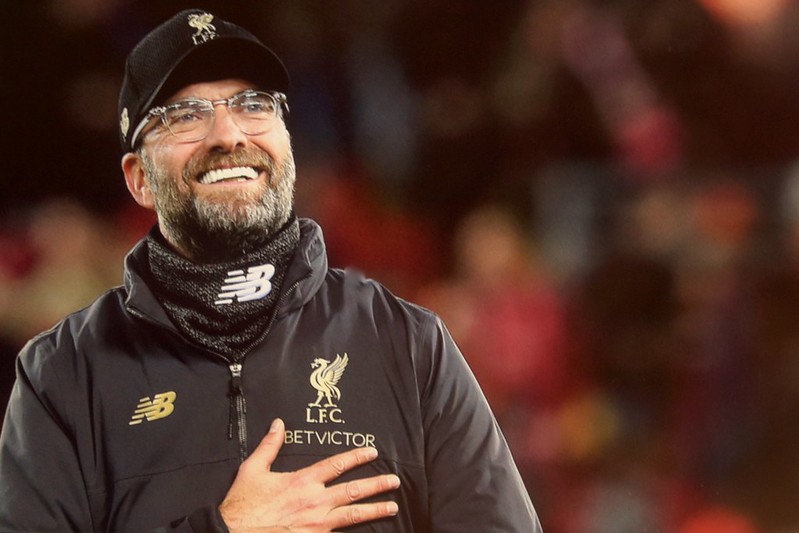
I was en route to Cork on 4 October 2015 when I saw the news that Brendan Rodgers had been sacked as Liverpool manager. Thoughts turned instantly to who’d be brought in to replace him, with Carlo Ancelotti and Jurgen Klopp purported to be the frontrunners. I didn’t think either of those were realistically attainable for where we were as a club at that time, so my preferred pick was Ronald Koeman, who was working wonders at Southampton.
Four days later, I was proven wrong. Liverpool proudly proclaimed Klopp as their new manager, with the German charming the pants off us all by advertising himself as ‘The Normal One’ – a thinly-veiled counter to Jose Mourinho’s brash self-declaration as ‘The Special One‘ when he took over at Chelsea in 2004 – and vowing to turn ‘doubters into believers’.
The path to success would be a marathon under the former Borussia Dortmund boss rather than a sprint. We were 10th when he took charge in October and finished 8th by May, but there were clear signs that he was breathing new life into a previously drifting Liverpool. Two cup finals in that first part-season showed that things were gradually moving in the right direction. The pulsating 4-3 win over Dortmund in the Europa League quarter-finals, when we twice came from two goals down on a night when we had to win, was added to the catalogue of iconic European occasions at Anfield.
The summer of 2016 presented Klopp with his first real opportunity to put his own stamp on the squad. In came Joel Matip, Gini Wijnaldum and – in a transfer which’d prove revolutionary – Sadio Mane. The opening day brought victory at Arsenal when we toyed with the Gunners until letting in two sloppy goals. We defeated eventual champions Chelsea at Stamford Bridge and brushed aside reigning title holders Leicester. Now we were seeing the ‘heavy metal football’ that our manager had promised.
There were still stumbles along the way – a nightmarish run midway through that 2016/17 season threatened to undo all of the progress we’d made up to that point – but on the final day of the campaign, a fourth-place finish was secured, and with it an all-important route back into the Champions League. Something was discernibly growing, a bit like the plant in Little Shop of Horrors.
Summer 2017 saw Andy Robertson arrive, as well as a man who’s become one of the greatest players in Liverpool history. Mo Salah’s signature wasn’t greeted with intrigue rather than a tidal wave of euphoria, but within a few short months he’d prove that his £36.9m transfer fee was an out-and-out steal. Klopp had also elevated a gifted youngster into the first-team fold by the name of Trent Alexander-Arnold.

Domestically we finished fourth again, but that campaign was all about the European journey. We swatted aside opponents who’d so often proven tricky for us in the past. We blitzed a Manchester City team who romped to the Premier League title with 100 points that season. Another Champions League final awaited, and while it ended in tears (literally for some of us) against Real Madrid, Klopp’s defiance afterwards screamed one message loud and clear. We’d lost the battle but not the war. This was a speed bump rather than a dead end.
By the start of the 2018/19 season, Liverpool was very much Klopp’s team. Alisson Becker had come in to nail down a goalkeeping position which previously had as much stability as me on an ice rink. Virgil van Dijk transformed a porous defence into a near-impenetrable brick wall. The pieces were finally in place to push for the prize that every Reds fan craved – the Premier League.
The domestic campaign ended with 97 points and one defeat, which incredibly was still only good enough for second as Man City finished on 98. It was beginning to feel as if a higher force had decreed that Klopp and Liverpool wouldn’t enjoy tangible success together, but one night in May 2019 illustrated that a mutual love story for the ages had been written.
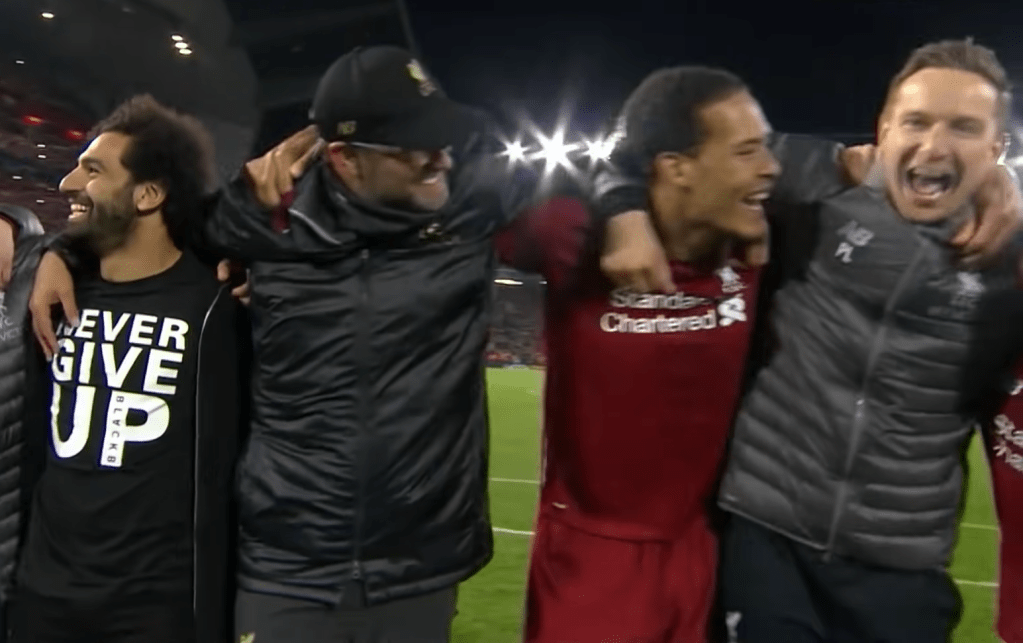
Trailing 3-0 to Barcelona after the first leg of the Champions League final, and with the away goals rule still in effect, only the most bullish of Reds fans would’ve hoped for that deficit to be overturned. It was cancelled out by the 56th minute, and indeed overturned when Alexander-Arnold took the most famous corner kick in football history, with clutch moments specialist Divock Origi finishing the ball to the net and sparking pandemonium. The proverbial Everest had been climbed. It was hard not to get emotional at seeing Klopp and the Liverpool squad, arm in arm in front of the Kop after the final whistle, singing along to You’ll Never Walk Alone with all their might.
There was still a final to be won, and that game against Tottenham was largely a forgettable 90+ minutes of football, but the how didn’t matter. Liverpool prevailed 2-0 and Klopp not only had a trophy at last; he had the biggest one in club football. European Cup number six had landed. Doubters were well and truly believers now…and the best was still to come.
I could live to 100 and I’ll never enjoy a season as much as 2019/20. After 27 league matches, our record stood at 26 wins and one draw. The wait for domestic supremacy was ending in unprecedented style…but what was actually unprecedented was the outbreak of COVID-19, which briefly threatened to wipe out the entire campaign. Surely not even Liverpool could be that cruelly unlucky?
Mercifully, the people in power had enough sense to resume the season once the pandemic had eased that summer. At roughly 10:10pm on Thursday 25 June 2020, the lifelong dream of a generation of Reds fans was finally realised. Liverpool were Premier League champions, and it was Klopp who led us to the summit. Like many of us, he was an emotional wreck that night. His accent and passport may still had been German, but his heart was Scouse.
That may have been the peak of his reign but there was still plenty to cherish. Two more trophies in 2021/22, a season in which we were two matches away from winning a unique quadruple. The potential for that historic achievement to still be realised this year. The hitherto successful replenishment of the squad after many heroes of the formidable team Klopp had built moved on. An unforgettable 7-0 drubbing of Manchester United (to go along with a 5-0 rout at Old Trafford).
When the now 56-year-old took charge at Anfield in 2015, Liverpool were the definition of a banter club. The previous season ended in the ignominy of a 6-1 hammering at Stoke, an insulting full stop to Steven Gerrard’s illustrious Reds career, and the first few weeks of the following campaign promised nothing but misery.
Fast forward to 2024, and this iconic club is again spoken about in hallowed tones across Europe. There’ll always be some bitter, deluded fools supporting other English clubs who can’t bring themselves to say a positive word about us, but their opinions are so blinkered and fuelled by hatred that they can be rendered invalid. There are dozens of people who’ve actively contributed to that transformation over the past decade, but none have played a bigger role than Jurgen Klopp.

When it was announced on Friday that he’d be leaving his role as Liverpool manager at the end of the season, the immediate reaction among the fan base was shock. And not ‘oh wow’ kind of shock – it was numbness, disbelief, despair, a pleading that this was merely a bad dream or an ill-conceived prank. Alas, no. It was real. The finish line is now in sight for Klopp at Anfield.
Not since Sir Kenny Dalglish’s sudden resignation in 1991 had Liverpool been shocked to its core in such a manner. The emperor who rebuilt the empire is to be no more from the end of May. From knowing that we’d have someone who’d confidently lead us through every storm, we now face into an ocean of uncertainty, doubt, fear, maybe even terror.
Results-wise, there have been plenty of managers who’ve matched or exceeded Klopp’s success. Sir Alex Ferguson is the obvious one, Pep Guardiola too. Arsene Wenger, Jose Mourinho and Ancelotti all spring to mind. However, at the highest level of football in my lifetime, I can’t recall any manager to have formed such an indelible bond with his club’s supporters as Klopp has at Liverpool.
He may have been pilloried for leading the hand-in-hand gesture in front of the Kop after a last-gasp 2-2 draw against West Brom a couple of months into his reign, but that was symbolic and had a wider meaning rather than being merely about that evening’s result. It was his way of telling the fans that we are a united front and we are building something here, but only with absolute buy-in and unity. The supporters duly responded. They knew this man from Stuttgart was now one of our own.
Predecessors such as Rodgers, Roy Hodgson and Rafael Benitez had never truly earned unyielding admiration at Anfield, either through being excessively aloof or simply overawed by the club’s aura. The difference with Klopp was that, almost without trying, he ‘got’ what Liverpool is all about. He seamlessly understood the culture of the club’s fan base, and that came across in how he communicated – and the fans duly let him know they realised that and greatly appreciated it.
From his ‘Boom!‘ exclamation after an emphatic win over Man City in 2016, to his charging onto the pitch to embrace Alisson in the wake of Origi’s stoppage time winner against Everton, to the triple fist-pump in front of the Kop which has now become his calling card, Jurgen Klopp has made himself a deity at Anfield.
Even if at times he’s been overly abrupt with reporters and referees, he carries a genuine warmth which is obvious to anyone who sees how he interacts with his players, or with individual supporters. He formed a heartwarming bond with Sean Cox after the Meath native was almost fatally assaulted before the Champions League semi-final against Roma in 2018; and with young Daire Gorman, the 12-year-old with Crommelin Syndrome whose meeting with the Liverpool manager towards the end of last year was one of the most poignant you’d ever see.
Whatever happens between now and the end of this season, Klopp has delivered my generation of Liverpool supporters the greatest days of their lives. Lovren against Dortmund. Mane at Goodison Park. Wijnaldum sending us on our way back to the Champions League. Salah lobbing Ederson from 40 yards. The fan park in Kiev. Origi against Everton, Newcastle and Barcelona. Champions League deliverance in 2019. Trent celebrating in the corner against Leicester during the title-winning season. Salah ripping off his shirt after scoring against Man United, the day that we finally dared to sing “we’re gonna win the league”. The night that we became Premier League champions. Alisson’s implausible stoppage time winner at West Brom. The 5-0 at Old Trafford. That first half against Man City in the FA Cup semi-final when we played arguably the finest football ever seen by a Liverpool team. The quadruple hunt of 2022. The 7-0 against United. All golden moments faciliated by Jurgen Klopp.
He turned even the most pessimistic of Reds fans from doubters into believers. As his chant goes, he delivered upon what he promised us during the dark times. He guided a club out of the storm and reached that golden sky of major silverware, overcoming adversity along the way. For the best part of a decade at Anfield, he made it a joyful experience to be a Liverpool fan, something which for a long time beforehand felt like a chore, an obligation to be fulfilled, an open invitation to be mercilessly mocked by supporters of other clubs.
The single best thing a human can do is to make another human happy. For Liverpool supporters, Jurgen Klopp did that on a continuous basis on the grandest of scales, and he’ll continue to do so until he takes charge of the club for the final time in May. That’s when the harsh, post-Klopp reality will truly hit. Until then, let’s appreciate this god on Earth while he’s still at Anfield. There’s no guarantee, of course, but the possibility remains that his send-off will be a glorious crescendo rather than a muted anti-climax. If it’s the former, it’d be most fitting for a man who’s defined a football club and who has our eternal gratitude.
(As for Koeman, he did end up on Merseyside, but it was for a less than cerebral spell at Everton which was characterised by public feuds with Martin O’Neill over Seamus Coleman’s fitness for Ireland duty.)
We’re so glad you’ve been a Red, Jurgen. Danke schön.
 Man, Ball and All