Earlier this week, the Republic of Ireland – along with Northern Ireland, England, Scotland and Wales – submitted a formal interest in co-hosting the 2028 European Championship, with a decision potentially set to be made by UEFA within the next fortnight. There have been reports of Russia also declaring an interest in hosting the tournament, but with the world’s largest country currently banned from international football activity after Vladimir Putin’s invasion of Ukraine, the chances of them hosting a second major football competition in 11 years thankfully seem farfetched.
It was in early February that Ireland and the UK announced their intention to bid for Euro 20208 hosting rights, a move which prompted some opposition on these shores as domestic football fans argued for the investment which would arise from that tournament to instead be put towards improving standards on and off the pitch in the country. Such a viewpoint is quite understandable – despite the best efforts of those involved, the League of Ireland often still struggles to deliver an attractive product in terms of the on-field action, the matchday experience and the optics of watching on TV (whenever LOI games are actually broadcast on TV, that is).
However, the positives of Ireland playing partial host to the second-biggest international competition in football should also be addressed. What a glorious opportunity this is for our nation to showcase itself to Europe and the world, with the host cities becoming a carnival for the thousands of fans set to descend upon the island.
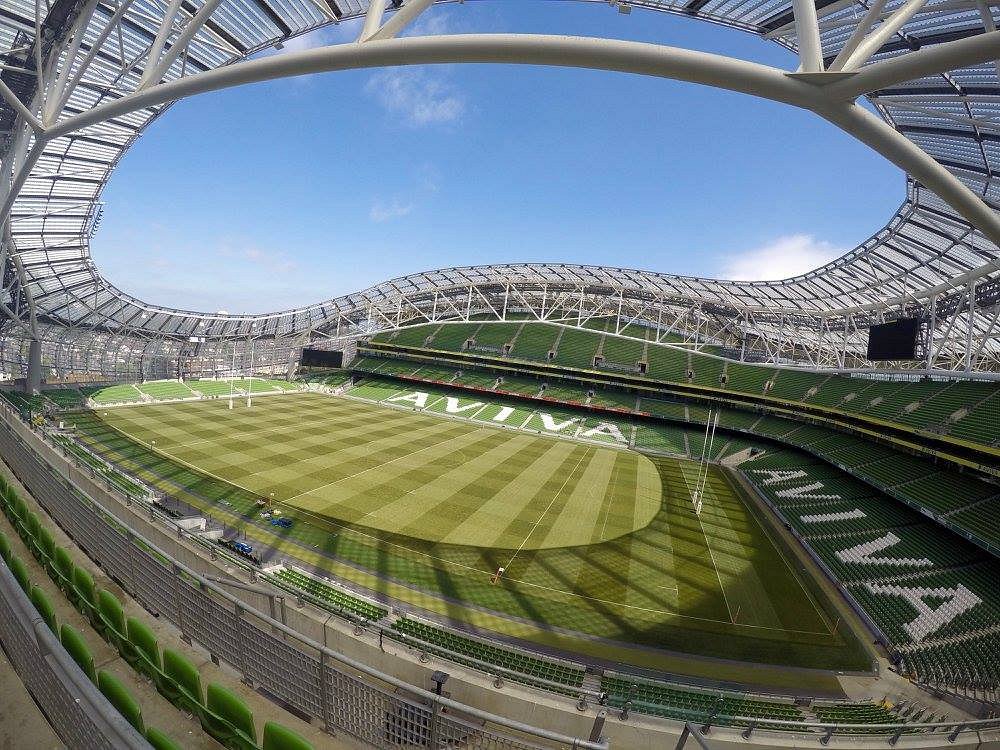
UEFA has given Ireland some morsels of big-game experience in recent years. The 2011 Europa League final was staged at the Aviva Stadium, while we hosted the European Under-17 Championship in 2019, a tournament which saw the likes of Brian Brobbey, Anthony Elanga, Joe Gelhardt, Fabio Silva and Karim Adeyemi flaunt their talents. It’s also worth remembering that Dublin’s flagship football venue had been due to host four matches at Euro 2020, including a round of 16 clash, only for it to lose those games due to being unable to guarantee spectator numbers as a consequent of the COVID-19 pandemic.
While that was the correct decision at a time when our country was in lockdown during the height of the virus, looking back there seems a sense of regret that last summer’s continent-wide extravaganza didn’t come to Dublin as originally planned. That should duly whet the appetite of Irish football fans to see our country finally getting its moment on UEFA’s biggest stage.
You may be wondering how Euro 2028 might look if, as hoped, the Ireland and UK bid emerges triumphant. At this stage it’s a guessing game, particularly when the last couple of years have shown just how quickly things can change when unforeseen events rear their head, but let’s get the imagination into gear and try to envisage how an Ireland-hosted Euro 2028 might be organised.
How many teams will take part and will we get an automatic place at the finals?
The last two European Championships have featured 24 nations, a 50% increase from before, although some reports have claimed that UEFA could raise the number of finals participants even further for 2028, with the possibility of a 32-team tournament not out of the question. This would give countries a mathematically greater chance of qualifying for the finals than missing out, as UEFA has 55 member associations, so logically it’s an expansion which shouldn’t happen.
It is traditional that a country hosting a major football tournament will be granted automatic qualification, but whether UEFA sticks with the current 24-team format or expands to 32 finalists, it seems improbable that Ireland and its fellow co-hosts would go straight into the finals. Were the tournament to remain at 24 teams, UEFA would be highly unlikely to sanction almost a quarter of its participants bypassing the qualifying stage. Even with a 32-team tournament, this would likely remain the case – indeed, UEFA published bidding information last year stating that no more than two nations would be granted automatic qualification.
Indeed, there is something of a precedent here, and a very recent one at that. Euro 2020 was staged across 11 countries, not all of whom played at the finals. Despite Baku and Bucharest hosting some of the matches, neither Azerbaijan nor Romania were at the finals. The same would also have been true for Ireland had Dublin remained a host venue.
Therefore, the prospect of the Boys in Green being locked out of its own party is a plausible one, although with a possible expansion to a 32-team tournament, you would like to think that we would surely manage to qualify in that instance. We are currently the 26th-best placed European nation in FIFA’s world ranking, so by that logic we should qualify, even if it is a close-run thing.
Would Ireland have the infrastructure and budget to cope with such a large-scale event?
The likelihood is that the island of Ireland would only have three host venues at most, possibly two if it is a 24-team tournament, so it’s not as if a Herculean effort would be needed across the entire country. The Aviva Stadium would be the obvious choice if the Republic gets one venue – if we get two, it would likely come down to a decision between using a second readymade Dublin venue in Croke Park, or selecting a second host city, most likely Cork. In the North, it seems a given that Belfast would be the host city.
The good news is that transport links between the aforementioned cities are already decent, with motorways connecting Dublin to both and a satisfactory public transport infrastructure which could easily be buffered for the duration of the tournament.
There is, of course, the logistical need to cater for visiting teams and supporters to each host city, but as already stated, Ireland would likely stage only a small portion of the tournament as a whole, so there would not be 20-odd teams descending upon Dublin Airport, plus a legion of spectators.
This country has past experience of hosting major world events, sporting or otherwise, with no enduring difficulty – think of the Special Olympics in 2003, or occasional papal visits, and the influx of people from other countries that those would have entailed. It’s also worth remembering that Qatar, a country whose land mass could fit into Ireland nearly seven times, is hosting a 32-nation World Cup on its own in just a few months’ time.
The question of budgeting and finance is thornier, though. Co-hosting Euro 2028 will bring with it a series of significant costs, such as improving transport infrastructure if needed and the possibility of renovating or building stadia. Security will be another major investment, with Garda resources set to be geared heavily towards the event.
If Ireland is to co-host Euro 2028, it seems inevitable that the taxpayer will be called upon to stump up some of the cost. At a time when much of the population is already struggling to keep up with the soaring cost of living, being asked to partially fund a tournament in which plenty of Irish citizens may not have any interest will not go down well. Indeed, in previous host countries of such major events, there have been protests over the hosting of football tournaments detracting from other significant fiscal priorities, such as healthcare and housing. These are both glaring issues in Ireland, the former even more so than usual after two years of trying to stem the tide of COVID-19.
Let’s say we overcome those barriers and co-host Euro 2028. How many games will Ireland get – firstly, if it’s a 24-team tournament?
Assuming the current 24-team format remains, there will likely be at least 10 venues between the five host nations. England will almost certainly have the bulk of these given their superior infrastructure, with the probability of either five or six English venues, one or two in Scotland, and one each in Wales, Northern Ireland and Republic of Ireland.
At least one of the venues will need to seat at least 60,000 spectators – Wembley exceeds this figure by some distance. There will need to be at least two more with 50,000 seats – Ireland has two such venues in the Aviva Stadium and Croke Park. Another four would need to hold 40,000 or more, with the remaining three having a minimum 30,000 capacity.
The Republic of Ireland would duly be covered, but there would be work to do north of the border if Belfast is to stage Euro 2028 matches. Even after redevelopment, Windsor Park has a capacity of just 19,000, less than two-thirds of the minimum requirement for the Euros, so bringing this up to the necessary 30,000 would be a substantial obstacle.
One alternative in Belfast is to renovate and reopen Casement Park, which is reportedly set to be revamped to a 35,000-seater venue. If this can be pulled off in the necessary timeframe, it would give Northern Ireland a stadium which meets the standards set out by UEFA.
A calculated guess at the venues for a 24-team tournament in Ireland and UK would be this:
England (5): Wembley (London), Old Trafford (Manchester), Anfield (Liverpool), Villa Park (Birmingham), St James’ Park (Newcastle)
Scotland (2): Hampden Park (Glasgow), Murrayfield (Edinburgh)
Wales (1): Principality Stadium (Cardiff)
Republic of Ireland (1): Aviva Stadium (Dublin)
Northern Ireland (1): Casement Park (Belfast)
All 10 venues would host at least three group matches and one knockout match, with the five host nations to be granted home fixtures in the group stage if they were to qualify.
The quarter-finals would be held in Liverpool, Newcastle, Cardiff and Dublin, with the semi-finals in Manchester and Glasgow and the final at Wembley. Where possible, a host nation will play in one of its country’s venues in the knockout rounds (i.e. the draw would be structured in such a way that, were Ireland to win their group and reach the last eight, their quarter-final would be in Dublin), but this would obviously depend on the composition of the draw relative to where each team finishes in its group.
The semi-finals would be in Manchester and Glasgow, and the final would then be at Wembley.
Seems manageable. Alright then, what if UEFA goes large with a 32-team finals?
Building upon the estimated host city breakdown above, there would be several English stadia ready to add straight away. Within London alone, you could easily have one of the Emirates Stadium, Tottenham Hotspur Stadium or West Ham’s London Stadium added to the mix. The Etihad Stadium would also be more than capable, although UEFA may be reluctant to grant Manchester two host stadia.
That’s the same dilemma which could befall Dublin if Ireland gets a third host venue from an expanded 32-team finals. Even though Croke Park is ready and waiting to use (assuming there is no repeat of the Rule 42 saga from the 2000s), it might not go down well if the capital city was to get both of the Republic’s venue picks.
That could see Cork being chosen as a host city, and it already has a 45,000 capacity stadium in Páirc Uí Chaoimh. However, as this too is a GAA venue, there would be hoops through which to jump in order for it to play host to football – there is already a precedent for this going back to the Liam Miller memorial match in 2018. Also, the east and west terraces would need to be converted to seating to satisfy UEFA requirements. Another doubt over Páirc Uí Chaoimh’s suitability is its location, which is far from the most accessible transport-wise and could send overseas visitors with a less than stellar sense of direction on an elongated tour of Blackrock or Ballintemple.
Therefore, it could happen that a new stadium is built in Cork for an expanded 32-team Euro 2028, if Ireland is to get a third host city. It would also give the FAI a workable alternative to the Aviva Stadium for hosting Ireland internationals, although the same could be said of the under-utilised Thomond Park. Indeed, with almost every under-21s and women’s international staged at Tallaght Stadium, the FAI seems to forget at times that it is allowed to use venues outside of Dublin.
If Cork were to get an all-new football stadium, it also throws up some immediate questions. Given the FAI’s reluctance to stage Ireland matches outside of the capital city, would this new venue quickly become a white elephant once Euro 2028 is over? Where in Cork would the new stadium be located? Would it be adequately served by public transport? Could it be built somewhere on the outskirts of the city which is already on a railway network?
Again, based on the optimistic assumption that these hurdles can be overcome, let’s envisage how a 32-team Euro 2028 might look:
England (6): Wembley (London), Old Trafford (Manchester), Anfield (Liverpool), Villa Park (Birmingham), St James’ Park (Newcastle), second London venue of either Emirates Stadium/Tottenham Hotspur Stadium/London Stadium
Scotland (2): Hampden Park (Glasgow), Murrayfield (Edinburgh)
Republic of Ireland (2): Aviva Stadium (Dublin), Croke Park (Dublin) or new venue in Cork
Wales (1): Principality Stadium (Cardiff)
Northern Ireland (1): Casement Park (Belfast)
The logical assumption would be that a 32-team Euros takes on the same format as the current World Cup, namely eight groups of four with the top two progressing to the last 16. This would ensure 48 group stage matches, with each of the 12 venues staging four games. Each venue would then get at least one knockout round match, potentially divided as follows:
Round of 16: Wembley, Manchester, Glasgow, Birmingham, Newcastle, Edinburgh, Belfast, Cork/Croke Park
Quarter-finals: Liverpool, Cardiff, Dublin (Aviva Stadium), second London venue
Semi-finals: Manchester, Glasgow
Final: Wembley
Of course it might not happen that Euro 2028 comes to these shores, but with a formal interest being declared, why can’t we begin to envisage what it might be like to have some of Europe’s best footballers descending upon this island of ours? If nothing else, it’s fun to at least imagine how it might all play out.
 Man, Ball and All